The List Taped Inside the Door
A shop checklist has one job: to remember the order of things so the installer does not have to. The same card, five lines long, can do that for the first ten minutes of any morning.
How a job starts at the bench
Nobody at our bench touches a car before the install order is on the clipboard. It does not matter if the job is a reversing camera we have fitted a hundred times or a roof rack we have fitted a thousand. The order gets written, the steps get numbered, and the sheet hangs from the side mirror where whoever is working can see it without turning around.
New installers sometimes find this insulting. They know the job, they say, so why write it out. The answer we give them is the one an older installer gave us: the sheet is not there because you might not know the job. It is there because you might get interrupted. A phone rings, a customer asks a question, a part turns out to be the wrong size, and when you come back to the car you have to find your place again. If the place is on paper, you find it in a second. If the place is only in your head, you find it by guessing, and the guess is where the loose connector or the forgotten screw comes from.
So every step gets a tick in the margin when it is done. Not when it is nearly done, not when you plan to do it after lunch. Done, then ticked. At the end, the sheet tells the truth about the job, and the person who checks the car before the customer drives away reads the ticks, not the installer's memory.
The same problem, at the front door
Here is a scene most of us know. It is a quarter to eight. You are dressed, the coffee is gone, you have somewhere to be. And you are standing in the hall patting your pockets, because the keys are not where they should be, the glasses are on top of your head or in the car or on the bathroom shelf, and the phone is charging in a room you have already left twice.
Nothing is wrong with you in that scene. You have simply asked your head to hold a list it was never given. The morning is full of small interruptions, a pan on the stove, a message, a dog at the door, and every one of them knocks something off the mental clipboard. Readers in their fifties and sixties tell us they notice this more than they used to, and it is a fair thing to notice. The fix the shop would suggest is not to try harder. It is to stop carrying the list in your head at all.
Writing the card
Take an index card, or the back of an old business card, and write five lines on it. Not ten. A checklist that is too long gets skipped, the same way a fifteen-step install order gets skimmed by the third car of the day. Five lines will cover almost everyone:
- Keys on the hook.
- Glasses in the case, the case in the pocket.
- Phone off the charger.
- Wallet, or whatever you pay with.
- The one thing that is different today.
That fifth line is the one the shop is proudest of. Every install order we write has a space marked "special," for whatever this car needs that the last one did not. At the door, it is the letter to post, the prescription to collect, the folder for the meeting, the umbrella. You write it on a sticky note the night before and put the note on the card. In the morning it is the only line you have to read with any care, because the other four are always the same.
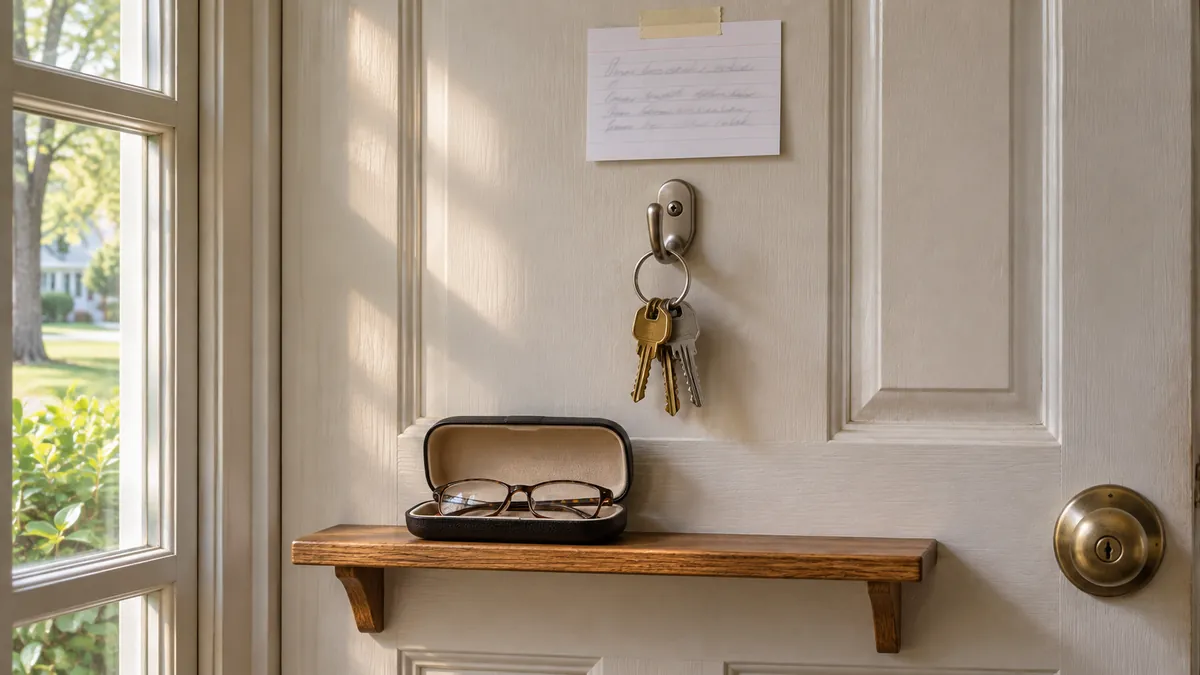
Tape the card inside the front door, at the height of your eyes, on the side of the door you see when you are about to open it. Not on the fridge, where it gets buried under photos and magnets. The door is where the decision to leave actually happens, so the door is where the list belongs.
Giving every item a place
A checklist only works if the things on it have homes. In the shop, every tool on the board has a painted outline behind it, so when a wrench is missing you see the empty shape from across the room. You do not have to remember that the wrench is gone. The wall tells you.
Do the same at the door. A hook for the keys, right under the card. A small dish or shelf for the glasses case. A charger that lives on the hall table instead of by the bed, so the phone sleeps where it will be collected. When you come in at night, everything goes back to its outline before your coat is off. It feels fussy for about a week. After that, the empty hook starts to look as wrong as an empty outline on a tool board, and your hands put the keys there before you have thought about it.
Ticking, out loud if it helps
The installer's tick is a small act of attention. You look at the step, you look at the work, and you agree that they match. At the door, the tick can be a touch: hand on the keys, hand on the glasses case, hand on the phone. Some people say the items under their breath, the way a pilot reads a checklist. It can feel silly. It also works, because saying a thing and touching it at the same moment gives the moment a little weight, and a moment with weight is easier to recall an hour later when you wonder whether you locked up.
Try it for two weeks before you judge it. Most habits that stick in the shop took about that long to stop feeling like extra work.
When the list grows
Some mornings are bigger than five lines: a trip, a hospital appointment, a day of errands. On those days, write a second card and clip it over the first. When the day is over, throw the second card away. The standing card stays short, and the special cards come and go. That is how the shop handles the cars that need more than the usual order: the base sheet does not change, and the extra sheet is stapled on top for that one job.
A yellow tag on this job
A card by the door helps with ordinary scatter. It is not meant for the kind of forgetting that frightens you or the people around you: getting lost on a familiar road, missing whole conversations, or a change that family members point out before you do.
If anything like that is happening, the right next step is a visit to a physician, not a better list. Bring a note of what you have noticed and when it started.