A Clean Dash
The most common thing we do to a dashboard is not adding something. It is taking things away, until the driver sees what the road needs and nothing that competes with it.
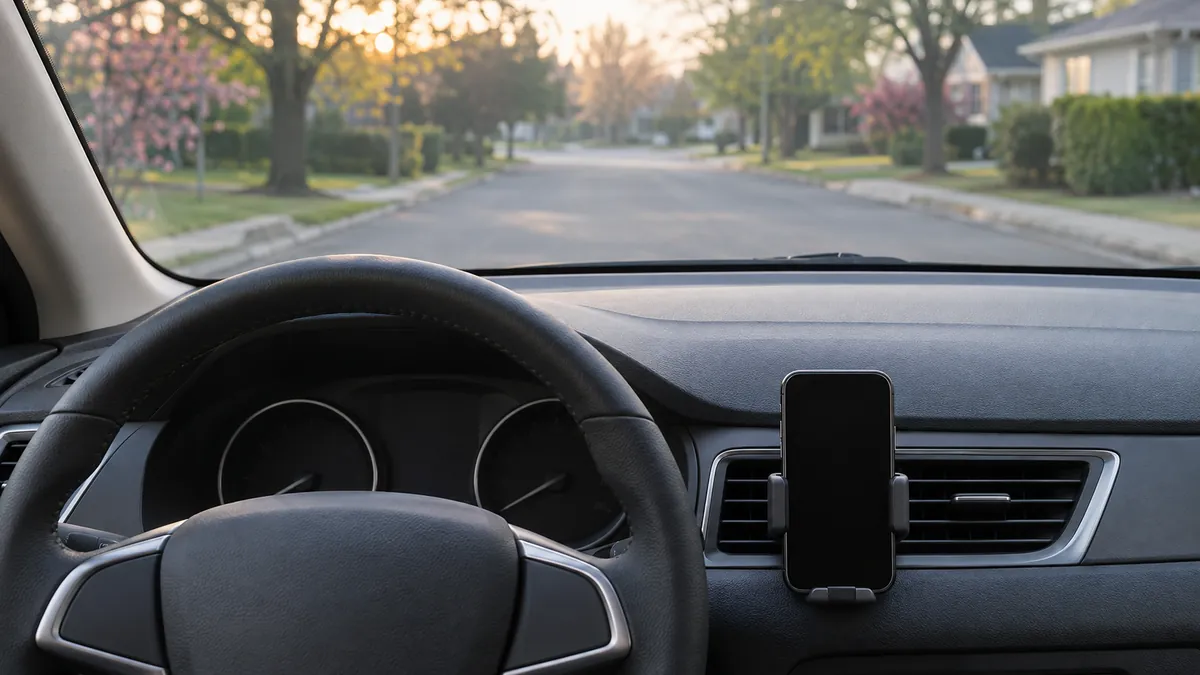
What comes in on a tow of good intentions
Cars arrive at the shop carrying years of small additions. A suction cup for a phone stuck in the middle of the windshield. A second phone holder clipped to a vent because the first one was in the wrong place. A dangling charger cable, a hanging air freshener, a parking permit, a sunglasses clip, a coin tray that slides every time the car turns. Each one went in for a good reason. Together, they make a dashboard that asks for a glance every few seconds.
When a customer asks us to fit something new, the first part of the install order is almost always a removal. We take off what is broken, what is duplicated and what sits in the driver's line of sight. Then we put the new part where it can be reached without the eyes leaving the road for long, and we route the cable so it is not swinging in the corner of vision. The customer usually notices the result before they notice the new part. The car feels quieter, they say, even though nothing about the engine changed.
Why the eye keeps getting pulled
Anything that moves, glows or changes catches attention whether we want it to or not. That is useful when the thing is a brake light ahead. It is costly when the thing is a notification sliding across a screen stuck to the glass. Every glance is a small switch: the mind lets go of the road, looks, decides it does not matter, and picks the road back up. Picking it back up takes a moment, and the moments add up over a drive.
Readers in their fifties and sixties often describe this switching as the part of the day that has become harder. Not driving itself, which they have done for decades, but driving while something else keeps asking for a look. The same goes for reading with the television on, or paying bills with a phone face up on the table. Research on attention has long looked at the cost of switching between tasks, and the general finding is easy to accept from experience: one thing at a time tends to go better than two things in turns.
The rule from the bench
Installers have a short rule for this, and we will put it plainly: one thing in view at a time, and everything else within reach but out of sight. A phone that is needed for navigation goes in a holder low on the dash, set up before the car moves, with notifications silenced for the drive. Cables run behind trim panels, not across the console. Loose items go in a closed compartment. What is left on the dash is what the drive actually needs.
You can apply that rule almost anywhere a task needs your attention.
- Before you start the car, set the route, set the music, and put the phone face down or in its holder with the screen dark. Decisions made at a standstill are cheaper than decisions made at forty miles an hour.
- At the table, keep one task in front of you. If you are writing a letter, the bills go in a folder. If you are paying bills, the newspaper goes on the chair.
- Keep a short pad within reach. When a stray thought arrives mid-task, the call you meant to make or the thing to buy, write it down in three words and go back to what you were doing. The pad holds it so your head does not have to.
- Give your phone a parking spot in the house, the way the car has a holder. When it is not in your hand, it is in the spot, face down.
Trimming, a little at a time
Nobody needs to strip a whole house in a weekend. In the shop we would never pull every accessory out of a car in one go without asking the owner what they use. Start with the one place where you most often lose your thread. For many readers it is the kitchen table, because it doubles as desk, mail sorter and charging station. Clear it down to one job for a week and notice how the work at that table feels.
Then take the rule to the car. Then to the chair where you read. Each time, ask the installer's question: what here is asking for my eyes that does not need to? Take that thing off the dash, so to speak, and put it somewhere you can reach without seeing it all day.
What a quiet dash gives back
Customers rarely come back to complain that we took too much off. More often they come back months later for another car in the family and ask for the same treatment. What they describe is not a feeling of being more skilled. It is a feeling of having fewer things pulling at them, so the skill they already have gets to work without interruption. That is a modest promise, and we are comfortable making only modest ones.
A yellow tag on this job
Trimming distractions is a routine, not a diagnosis. If you find yourself drifting at the wheel even on a clear dash, missing turns on routes you know well, or feeling foggy through most of the day, stop driving those routes until you have spoken with a physician.
Medicines, sleep and many ordinary health matters can affect attention, and only a doctor who knows your history can sort out which one applies to you.